Kentish Flats Extension used fixed monopile foundations (one per turbine). Transition pieces are reported as ~160 t each (topside/transition piece weight reported in project coverage) but a per-monopile gross weight for the steel pile is not explicitly stated in the available sources.
100% ROC
In December 2021, Vattenfall awarded HARCO Heavy Lifting a 2022–2025 main component exchange contract covering Kentish Flats Extension and four other UK offshore wind farms, with on-site work expected to start around the end of January 2022 and involving large-scale replacement of gearboxes, generators, main shafts and blades using specialised lifting tools and crews.
The third and final year of post-construction bird monitoring surveys for the Kentish Flats Extension Offshore Wind Farm, covering the period from October 2017 to March 2018, was completed, and a report was produced analysing all post-construction data to compare key seabird species’ distribution and abundance against the pre-construction baseline to determine the effects of the development, including its offshore infrastructure and export cables.
Between October 2017 and March 2018, the third and final year of post-construction bird monitoring surveys for the Kentish Flats Extension Offshore Wind Farm, which includes the export cable route to Hampton Pier and the onshore connection to Red House Farm substation, was undertaken to assess seabird distribution and abundance at the KFE site and its surrounds after construction and compare results with the pre-construction baseline.
Between 27 October 2017 and 29 March 2018, Jon Ford Environmental Consultancy carried out the third and final year of post-construction bird monitoring at Kentish Flats Extension, using standard boat-based transect methods to survey seabird distribution in and around the 15‑turbine extension and compare post-construction conditions with the pre-construction baseline.
From October 2016 to March 2017, Vattenfall undertook the second year of post-construction ornithological monitoring at Kentish Flats Extension, conducting repeated boat-based line-transect surveys around the KFE turbines and wider site to assess seabird use of the area following construction.
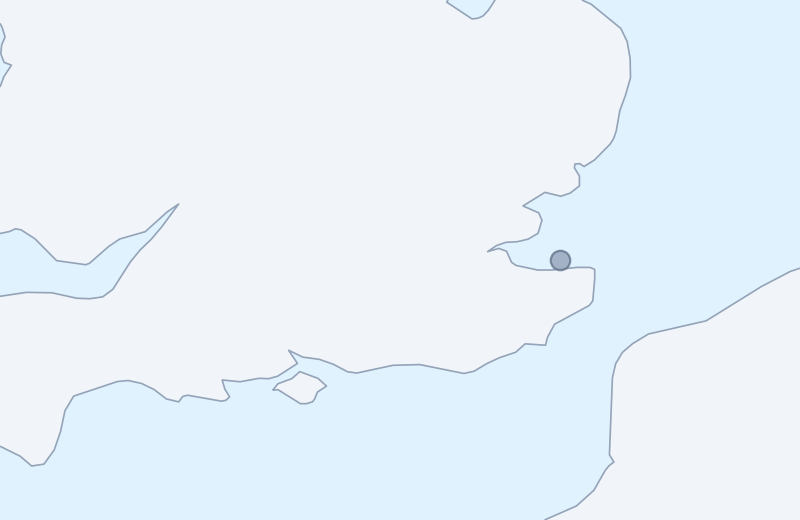
On 6 June 2016, Vattenfall formally inaugurated the Kentish Flats Extension offshore wind farm, a 15‑turbine, 49.5 MW scheme located about 7 km off Whitstable and Herne Bay, highlighting its role as a cost‑reduction demonstrator for offshore wind and showcasing innovations such as novel foundations and longer blades.
During the 2015 construction of the Kentish Flats Extension, two 33 kV export cables for the extension were installed alongside the existing Kentish Flats export circuits, running offshore from the turbine array to landfall near Hampton Pier, Herne Bay, and then along the established onshore route to the Red House Farm substation; the 18 km export system and associated 12 km of inter-array cabling were buried using water jetting to a depth of approximately 0.5–2 m below the seabed.
During the 2015–2016 winter season, Vattenfall carried out post-construction ornithological monitoring at the Kentish Flats Extension offshore wind farm, using defined survey transects across the KFE turbine area and adjacent original Kentish Flats site to track seabird distribution and abundance around the operational extension.
In early December 2015, Vattenfall’s Kentish Flats Extension project team handed the completed offshore wind farm over to the company’s Operations & Maintenance department, marking the transition from construction into routine operational management of the 49.5 MW extension adjacent to the original Kentish Flats array in the Outer Thames Estuary.
Between February and September 2015, Vattenfall carried out offshore cable termination and testing for the Kentish Flats Extension, supported by RMS Submarine and eos projekt, as part of commissioning activities prior to handing the project over to the operations and maintenance team.