Hywind Scotland uses spar-buoy floating substructures with a three-point mooring (three suction anchors per turbine); mooring spread radius reported as 600–1,200 m in project documentation.
100% ROC+ 1 PPA
In Equinor’s decommissioning programme for Hywind Scotland, decommissioning of the project, including full removal of the single export cable that connects the offshore turbines to shore, is planned for Q2/Q3 2038, with site operations expected to be completed within a five‑month window. The programme assumes that all removed cables and associated export‑cable equipment will be taken ashore for recycling or disposal following recovery.
Equinor’s decommissioning programme for the Hywind Scotland Pilot Park states that, after a 20‑year design life and opening in October 2017, decommissioning activities are scheduled to begin in Q2 2038. The base case is to remove all offshore components in reverse order of installation, including the single export cable (a mainly static ~25–27.5 km HVAC 33 kV link with a short dynamic section up to turbine HS5), with detailed cable recovery using offshore construction vessels, winches and water‑jetting to expose and retrieve buried sections, subject to final environmental assessment.
In 2024, Equinor and Masdar executed a heavy maintenance campaign on all five turbines at the 30 MW Hywind Scotland floating wind farm. The Siemens Gamesa turbines were disconnected and towed to the Wergeland Base in Gulen, Norway, where major maintenance was performed in a controlled, sheltered environment before the units were returned offshore and reconnected at the site off Peterhead.
In 2022, Marine Scotland, in collaboration with Equinor as operator of Hywind Scotland, conducted a survey at the floating wind farm to test three types of fishing gear—creels, fish traps and jigging lines—around and within the project area. The work aimed to understand how different fishing methods can safely operate in and interact with floating offshore wind farms, providing evidence to support coexistence between fisheries and floating wind developments.
In June 2020, an environmental and structural inspection survey was carried out at the Hywind Scotland Pilot Park using a work-class ROV with high-definition video, deployed from the survey vessel M/V Stril Explorer. The campaign examined turbine substructures, mooring lines, suction anchors and infield cables to assess colonisation, zonation, diversity and abundance of fouling communities, and to compare epifouling coverage and thickness with earlier observations from 2018.
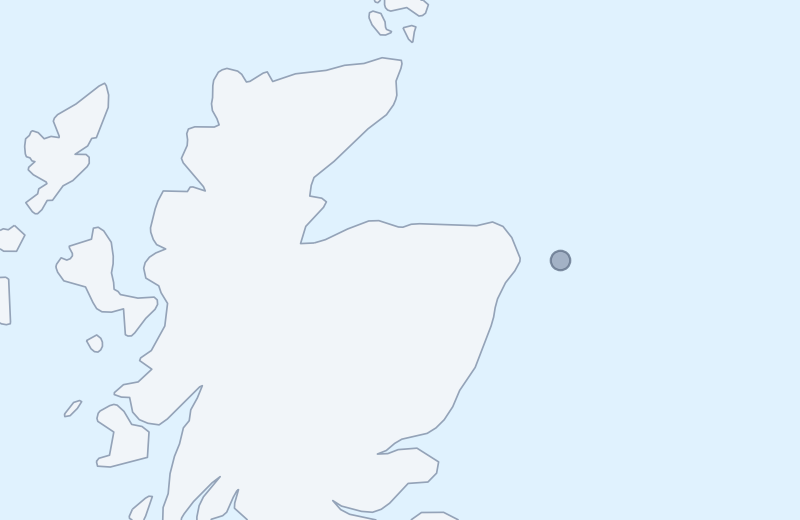
In 2017 the foundation works for the Hywind Scotland Pilot Park were completed at Buchan Deep, with five spar-type floating substructures and their associated moorings and suction anchors installed in water depths of around 100–130 metres, forming the world’s first commercial floating offshore wind farm about 25 km off the Scottish coast.
By 2017 installation of all five Siemens Gamesa 6 MW turbines on their spar floating substructures at the Hywind Scotland site off north-east Scotland was completed, creating a 30 MW pilot park that became the first multi-turbine floating offshore wind farm in the UK and was officially opened later that year.
Ahead of construction of the 30 MW Hywind Scotland floating wind farm at Buchan Deep, 25 km off Peterhead, Statoil indicated that first power from the five 6 MW turbines was expected to be generated towards the end of 2017, following turbine deployment earlier that year.
In The Crown Estate’s May 2016 announcement of the seabed lease for Hywind Scotland, Statoil indicated that offshore deployment of the five 6 MW floating turbines at the Buchan Deep site, approximately 25 km off Peterhead, was due to begin in 2017 as part of the project’s construction programme.
Equinor’s Hywind Scotland export cable and associated grid connection to the SSE Peterhead Grange substation entered commercial operation in October 2017, when the five‑turbine, 30 MW Hywind Scotland Pilot Park was opened. The project’s single 33 kV AC export cable, linking the offshore floating wind farm at Buchan Deep to shore and into the local distribution network at Peterhead Grange, thus began continuous commercial transmission service as part of the fully operational wind farm.