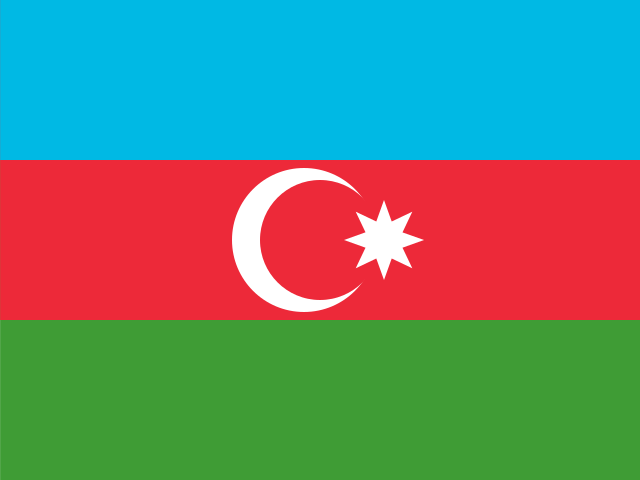
Azerenerji OJSC (also referred to as Azerenergy or AzerEnerji JSC) is Azerbaijan’s state‑owned electric power utility and the dominant player in the national power system. Headquartered in Baku and fully owned by the Government of Azerbaijan, it is responsible for electricity generation and high‑voltage transmission across the country and historically has also carried out distribution in Baku and the regions, excluding the Nakhchivan Autonomous Republic. The company controls over 95 per cent of generation and 98 per cent of transmission in Azerbaijan and is described as the largest power utility in both Azerbaijan and the wider Caucasus region, with total installed generation capacity of around 6.8–6.9 GW and annual output of about 22 TWh in 2014.
Azerenerji operates a mixed generation portfolio dominated by natural‑gas‑fired thermal power plants, complemented by large hydropower assets. Its fleet includes the 2,400 MW Azerbaijan Thermal Power Plant and a series of combined‑cycle and modular gas plants at Shirvan, Shimal, Janub, Sumgait, Sangachal, Shahdagh, Baku, Khachmaz, Astara, Sheki, Nakhchivan and Babek. Major hydropower stations under its control include Mingechevir, Shamkir, Yenikend, Varvara, Araz and Vaykhir, with additional capacity such as the Fuzuli HPP under development. The company owns more than 200 high‑voltage substations at 110–500 kV and a backbone transmission network of roughly 8,700 km, while total transmission and distribution line length, including medium and low voltage, exceeds 100,000 km.
Beyond meeting domestic demand and underpinning energy security, Azerenerji manages cross‑border power exchanges with neighbouring systems in Russia, Georgia, Turkey and Iran and participates in regional initiatives such as the Azerbaijan‑Georgia‑Turkey power bridge. Its strategy, supported by state investment and international financial institutions including the World Bank and EBRD, focuses on modernising substations and transmission corridors, improving efficiency, and enabling large‑scale integration of renewable energy. The company has a formal corporate social responsibility framework that references Sustainable Development Goals on gender equality and reduction of inequality, and it implements policies to promote women’s participation in technical and managerial roles, inclusive workplace practices and non‑discrimination.
 AZactiveUtilityState-Owned· 1 project